Sweatt v. Painter : Gallery
Explore the Gallery walls
Legal History (West Wall)
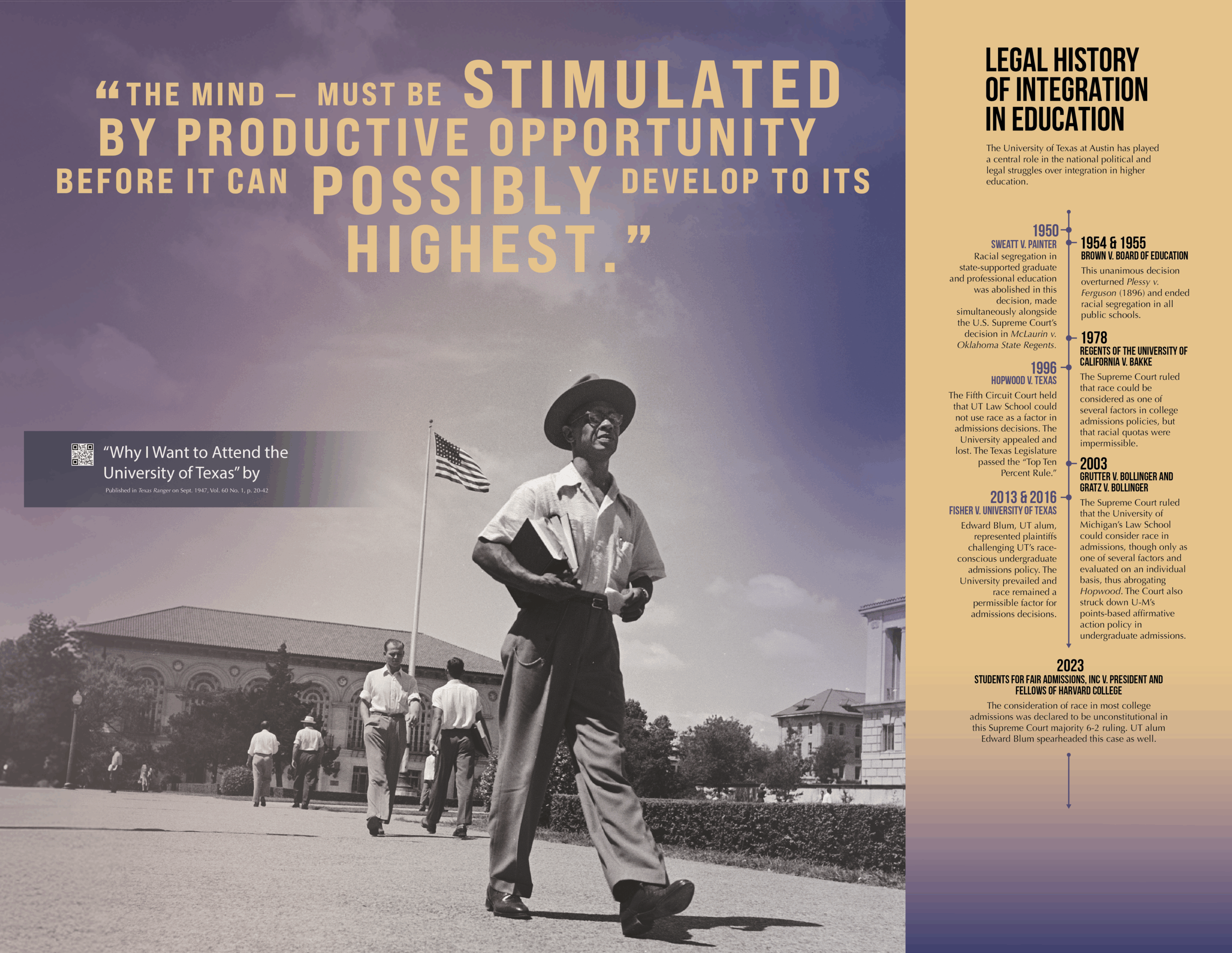
“Why I Want to Attend the University of Texas” by Heman Marion Sweatt
Published in the Texas Ranger on Sept. 1947, Vol 60 No. 1 pg. 20-42.
Dolph Briscoe Center for American History, The University of Texas, Austin, TX.
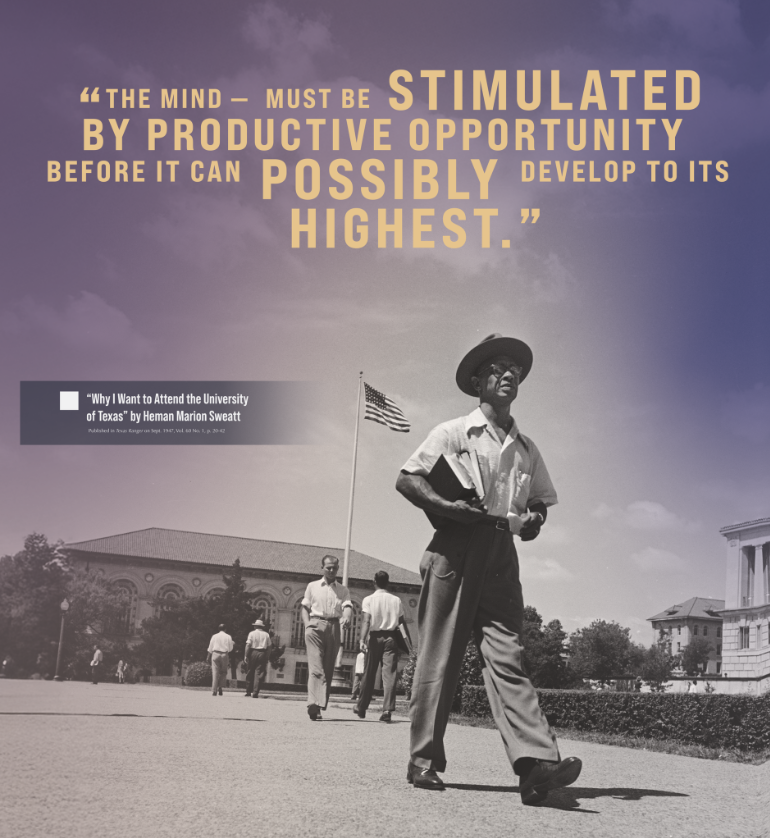
Photograph by Joe Scherschel, 1950, The LIFE Picture Collection/Shutterstock (12067025a).
Heman Marion Sweatt walks across the University of Texas campus in August 1950.
Legal History of Integration in Education
The University of Texas at Austin has played a central role in the national political and legal struggles over integration in higher education.
1950
Sweatt v. Painter
Racial segregation in state-supported graduate and professional education was abolished in this decision, made simultaneously alongside the U.S. Supreme Court’s decision in McLaurin v. Oklahoma State Regents.
1954 & 1955
Brown v. Board of Education
This unanimous decision overturned Plessy v. Ferguson (1896) and ended racial segregation in all public schools.
1978
Regents of the University of California v. Bakke
The Supreme Court ruled that race could be considered as one of several factors in college admissions policies, but that racial quotas were impermissible.
1996
Hopwood v. Texas
The Fifth Circuit Court held that UT Law School could not use race as a factor in admissions decisions. The University appealed and lost. The Texas Legislature passed the “Top Ten Percent Rule.”
2003
Grutter v. Bollinger and Gratz v. Bollinger
The Supreme Court ruled that the Universit of Michigan’s Law School could consider race in admissions, though only as one of several factors and evaluated on an individual basis, thus abrogating Hopwood. The Court also struck down U-M’s points-based affirmative action policy in undergraduate admissions.
2013 & 2016
Fisher v. University of Texas
Edward Blum, UT alum, represented plaintiffs challenging UT’s race-conscious undergraduate admissions policy. The University prevailed and race remained a permissible factor for admissions decisons.
2023
Students for Fair Admissions, Inc v. President and Fellows of Harvard College
The consideration of race in most college admissions was declared to be unconstitutional in this Supreme Court majority 6-2 ruling. UT alum Edward Blum spearheaded this case as well.
Explore & Learn More
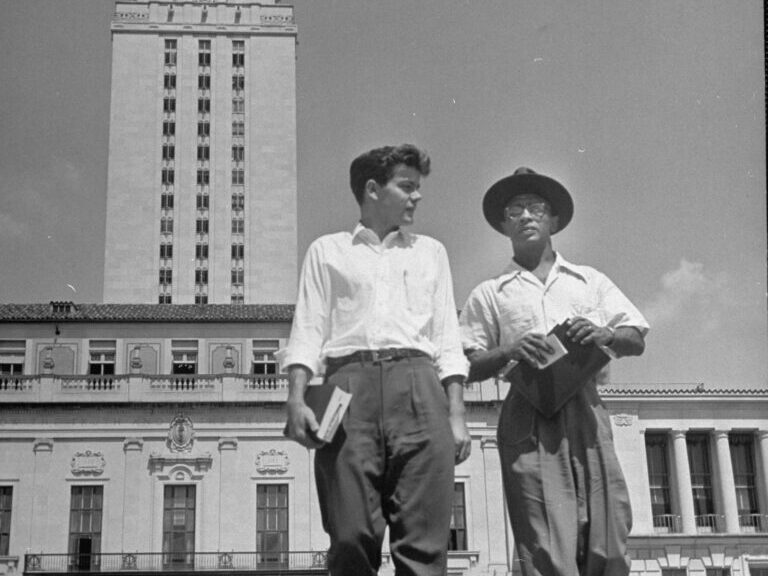
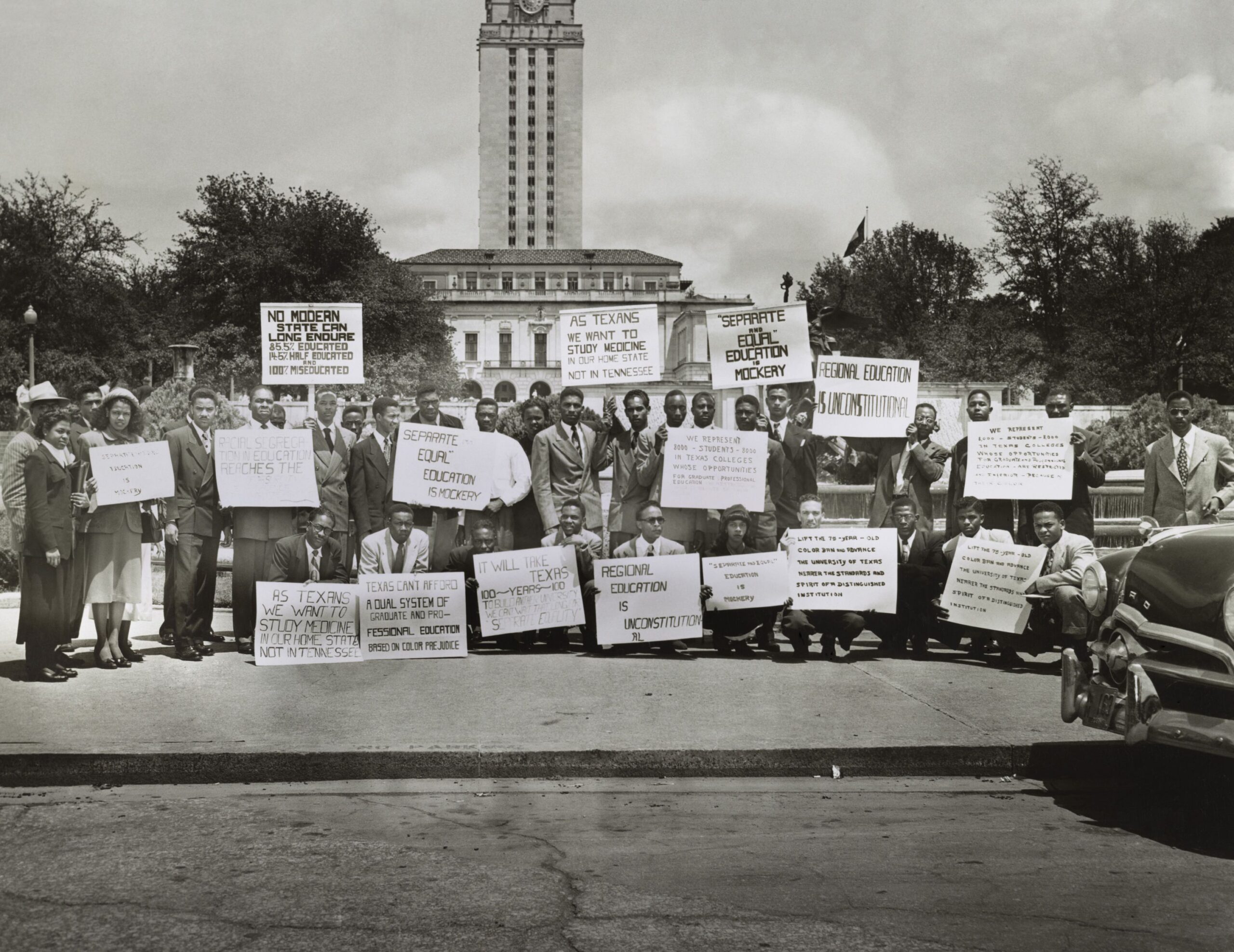
Learn more about Heman Marion Sweatt and other key figures and their legal struggle for racial equity in higher education at UT and in the nation.